Chris Van Emmerik
Senior Full Stack Engineer
I build complete products — information architecture, backend, UI, and the unglamorous details in between.
Backed by a B.S. in Computer Engineering. I build AI-forward and lean on AI-assisted tooling across my workflow, and I care about speed, craft, and software that feels obvious to use.
Experience
Twenty-two years, two chapters
Thirteen years building and leading product engineering in regulated gaming, then eight-plus years shipping full stack platforms end to end as an independent software engineer.
2017 — Present
Independent · ContractOwner & Full Stack Software Engineer
Greenlink Services LLC · Development and Consultancy · Longmont, CO • Lead, SD
As the sole engineer, I take client engagements end to end — architecture, implementation, deployment, and years of ongoing operation. AI-assisted tooling runs throughout my workflow — rapid prototyping, code review, testing — so more time goes to the architecture and UX decisions that matter.
I work with clients through direct contract or via Upwork, where I've earned $300k+ across 3,800+ hours logged for 30+ clients with a 100% job success score.
Noteworthy Projects
A selection of the work I'm most proud of.
- The problem: browsers and cloud servers can't reach thermal printers, which speak proprietary binary protocols over raw TCP/USB on the local network — and Star's own cloud paths (CloudPRNT polling, MQTT) can't print image receipts fast enough.
- Built the missing edge “bridge” that caches templates, renders locally, and pushes print data straight to the printer over USB/Ethernet — ~40ms locally, ~97ms over the cloud.
- Designed a “pseudo-SVG” template format for speed: an SVG template plus dynamic JSON transforms to an SVG image, then to printer binary. Both hops are extremely fast — the quickest render path I found for image-based receipts, not just text.
- Cut render latency ~50x (600ms to 12ms) with a custom ttf-parser text-to-path pre-processor that eliminates the rasterizer's system-font resolution — verified byte-identical output before shipping.
- Real-time status, presence, and job dispatch over AWS IoT MQTT — chosen as a lightweight pub/sub transport that scales to large device fleets cost-effectively; per-org-scoped policies, plus deliberate offline-first failover to a LAN HTTP bridge so the register keeps printing when the internet drops.
- Shipped the public developer SDK — the receiptkit npm package — with two transports: a one-line fire-and-forget HTTP call for simple integrations, or direct MQTT pub/sub for real-time work (low-latency printing, live printer and bridge status, device discovery, and presence), plus React hooks and a synchronous status cache so UIs read live device state without async round-trips.
- Designed and built the entire customer dashboard end to end: a live overview (bridges online, prints today with day-over-day trends, average print latency), a real-time print-jobs feed, and per-device pages showing live printer hardware status straight off MQTT — plus template, API-key, billing, and team management.
- Built remote over-the-air bridge updates with automatic rollback: an admin picks any target version from the dashboard, the desktop (Tauri) bridge applies a signature-verified installer while streaming live download progress back over MQTT, and the Raspberry Pi bridge does an atomic install-directory swap gated by a post-restart health check that auto-reverts to the prior version if the new build fails to come up.
- Built a remote-view feature that mirrors a bridge's live UI into any browser over MQTT: a short-lived org-scoped session token connects to AWS IoT, the bridge streams chunked state snapshots every few seconds, and the page renders the exact same shared React components as the native desktop app or Raspberry Pi device — so support can watch printers, the queue, logs, and history in real time and even invoke commands remotely, identical to standing in front of the device.
- Built the visual editor — a drag-and-drop SVG template designer with dynamic, data-bound elements and fields that render live against real order data.
- Three AI authoring paths with Claude: generate a template from a text prompt, refine an existing one through incremental AI edits, or photograph a paper receipt and get an editable template back via vision — all SSE-streamed.

Customer dashboard overview — bridges online, prints today with day-over-day trend, average print latency over the last 7 days, and a live print-jobs feed.
- Full commerce stack: Stripe + PayPal checkout, subscriptions, dynamic tax, multi-warehouse ShipEngine/FedEx live rating, in-store pickup, returns with prepaid labels, and customer accounts with order history, tracking, and authentication.
- Faceted catalog search across 150,000+ SKUs with Algolia InstantSearch, surfacing live per-store inventory and pricing from MySQL.
- Built the analytics layer end to end — instrumented the full e-commerce funnel from add-to-cart through purchase and conversion across GA4, Google Ads, Bing UET, Facebook Pixel, and Algolia, with enhanced conversions and per-item category dimensions.
- Operational monitoring and alerting on Axiom server logs — a standardized error-handling layer across the API routes emails the team the instant a checkout, payment, or fulfillment error fires, with request-ID correlation for fast triage.
- Selective LogRocket session replay on the checkout and order-confirmation screens, with client-side errors and analytics failures bridged back to server logs to diagnose browser-side incidents end to end.
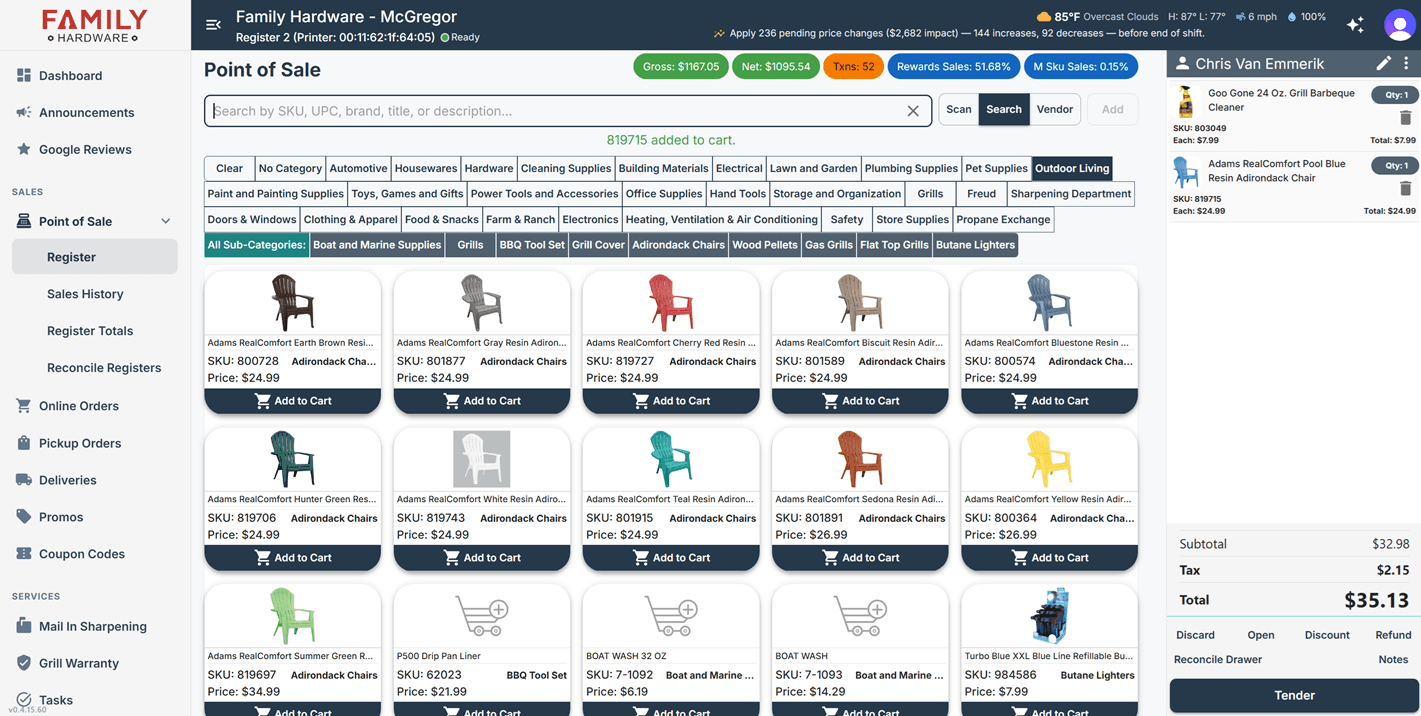
- The point-of-sale register — the highest-stakes screen in the business: a live cart driven by scan-to-add SKU input with fast item find, line-item discounts and price adjustments. Checkout via cash, credit-card, customer invoice, gift card, and split tender payments, along with receipt integration, refunds, and return processing — all reconciled through Stripe and the owner's backend databases.
- Designed the discount engine from scratch: cart and line item discounts across percent, fixed, and preset amounts, per-customer tier pricing (percent-off-retail or cost-plus margin), and SKU-targeted coupon codes with use limits, expiries, and product-level non-discountable flags.
- Full refund workflows across credit card and cash, including partial returns and split tenders, with per-line-item tracking that caps refundable quantities and prevents over-refunding before anything reaches Stripe.
- In-person payments via Stripe Terminal, receipt printing over Star CloudPRNT plus a custom local print bridge, and real-time register/device messaging over AWS IoT MQTT.
- Accounts receivable, end to end: on-account invoicing, customer credits from returns and overpayments, automated monthly finance charges, an accounts-aging dashboard, and statements sent by email or physical mail — with AI-drafted collection emails.
- Deep back-office breadth: product and inventory management with duplicate guards and inventory-health advisories, Algolia search, multi-carrier fulfillment via ShipEngine across pickup, delivery, and online orders, purchase orders and suppliers, plus warranty and mail-in tool-sharpening workflows.
Private / internal tool- Created and maintain the public React platform behind MIND — used by clinicians and patients worldwide to find safe, effective mental-health apps.
- 600+ mental-health apps evaluated against 105 objective criteria from the American Psychiatric Association's evaluation framework.
- Built the data pipeline behind the ratings: a serverless CORS proxy (AWS Lambda) wraps the Apple App Store and Google Play scrapers — normalizing and whitelisting fields and adding CORS headers so the browser app pulls live store metadata (icons, screenshots, install counts, in-app-purchase and pricing flags) directly, in multiple languages — then merges it with human rater reviews and runs it through an approval workflow that governs how ratings are published and kept current.
- Designed the DynamoDB data architecture behind the ratings: an append-only, versioned store where every rating is an immutable record — linked to its app by a groupId and to the revision it came from by a parent pointer — so one app accrues many ratings over time, each moving through a draft-then-approved workflow with the full history preserved. The public sees only the newest approved rating per app (resolved by grouping on groupId and taking the most recent approved record); raters and admins work against the whole chain.
- Built a virtualized app catalog that stays fast at scale — a windowed list (react-virtualized) with dynamic row measurement renders only the visible rows, so faceted filtering and fuzzy search across the full 600+ app catalog stay smooth and instant.
- Built an automated survey reminder system on AWS Lambda and SES: a scheduled job scans the survey tables, determines when each participant's next follow-up is due (Initial, then 2-week, then 6-week), and emails a deep-linked survey — recording what's been sent so no one is emailed twice or after they've already responded.
- Implemented as an installable PWA with usage logged to a dedicated DynamoDB tracking table, giving the team real-world engagement analytics.
- Co-founded the product and designed the cloud architecture from the ground up: a single React/Redux codebase that ships as an offline-first PWA and, through Cordova, as native iOS and Android apps — one source base across web and mobile.
- Built the point-of-sale register end to end — a scan-to-add live cart, an age/ID-verified customer queue, cash and card tenders, and Colorado cannabis tax computation (city, county, state recreational, and cannabis excise) itemized to the cent on every receipt.
- Architected offline-first data sync: a background transaction queue reconciles local state with the server so registers keep selling through network drops, with SignalR pushing live updates across devices the moment connectivity returns.
- Integrated METRC — Colorado's state seed-to-sale compliance system — for package tracking and regulated reporting across multiple retail locations.
- Direct integration with native peripherals, including Star Micronics printers and Socket Mobile scanners.
- Owned deployment and scale — Dockerized .NET Core services with PostgreSQL, deployed to Google Kubernetes Engine (GKE) on Google Cloud Platform, plus the release process and scaling plan.

Point-of-sale register — scan-to-add live cart, category-filtered inventory, and an age/ID-verified customer.
2004 — 2017
Full-timeManager, Software Engineering
Gaming Laboratories International · Wheat Ridge, CO
Thirteen years building and leading product engineering at the world's largest gaming test lab — shipping verification tools, compliance platforms, and performing numerous forensic investigations.
- Developed the product from the ground up in managed C#, C++, and unmanaged C++.
- Implemented an Ext2/Ext3 file-system driver enabling Windows to read and hash Linux files and directories on Linux partitions.
- Device-level signature methods for partitions, MBR, CD/DVD, and CF cards; worked directly with gaming manufacturers on proprietary hardware signature methodologies.
- Built client-level snapshot replication: logged-in clients pull a local snapshot of their approval database from the central system, so every signature they compute is matched against it automatically — instantly identifying the exact game or software build and its regulatory approval status.
- Led the conversion from freemium tool to subscription service exceeding $500k annual revenue.
- Performed 60+ forensic investigations, authoring the technical legal reports and expert opinions that documented the findings.
- Extracted and dumped RAM from physical gaming devices, then analyzed memory and source code to pinpoint bugs and points of failure.
- Reproduced reported malfunctions on live hardware, documenting each step of the analysis as it happened.
- Used in-circuit emulation and hardware debuggers to step through live source on physical devices, tracing code paths to hardware behavior.
- Partnered with compliance and engineering management to build out the practice's testing methodology and procedures.
- Created and established the project; adopted by 6 US regulatory jurisdictions at the time, and now supported by virtually all gaming manufacturers.
- Generated testing revenue exceeding $1M annually.
- Designed the database structures, Windows calculation services, and integrations with GLI's product line.
- Designed and developed the product from the ground up, then built and led the team that ran it.
- Customer onboarding with automated data import and mismatch-resolution UI, real-time status notifications, dynamic change-request workflows, and a regulated-shipping interface.
- Co-designed the product; implemented the communication protocol between the embedded device and its tablet front end.
- Integrated Verify+ hashing/verification engines with a C# WPF tablet UI; managed contract hardware and software engineers.
2000 — 2004
B.S. Computer Engineering
University of Wyoming · Laramie, WY
Computer Engineering: where software meets hardware — the foundation for a career that has spanned both.
Capabilities
Full stack means the whole stack
Depth across the modern web plus the low-level foundation most web engineers never get.